
Ellsworth County Criminal Court Records
A criminal court record is the court's case record for a prosecution. In Ellsworth County, felony cases and state-law misdemeanor cases are district court matters. The record can include the charging document, bond orders, first appearance, preliminary hearing entries, arraignment, plea records, motions, hearing notices, warrants and returns, diversion filings if filed, sentencing journal entries, probation orders, restitution, fines, and post-conviction motions. It is broader than a single charge screen and narrower than a statewide criminal-history report.
Ellsworth County District Court is part of the 20th Judicial District with Barton, Rice, Russell, and Stafford counties. The Kansas Judicial Branch identifies Chief Judge Carey L. Hipp, District Magistrate Judge Peggy Svaty for Ellsworth County, and Clerk of the District Court Kristy Battershell. City ordinance and city traffic violations may be in Municipal Court, while state criminal prosecutions are routed through District Court. For a closer look at the accusation itself, the charge-focused record is separate from the full case file in Ellsworth County court charge records.
The Ellsworth County Attorney source is one successful image source for this criminal court records page.
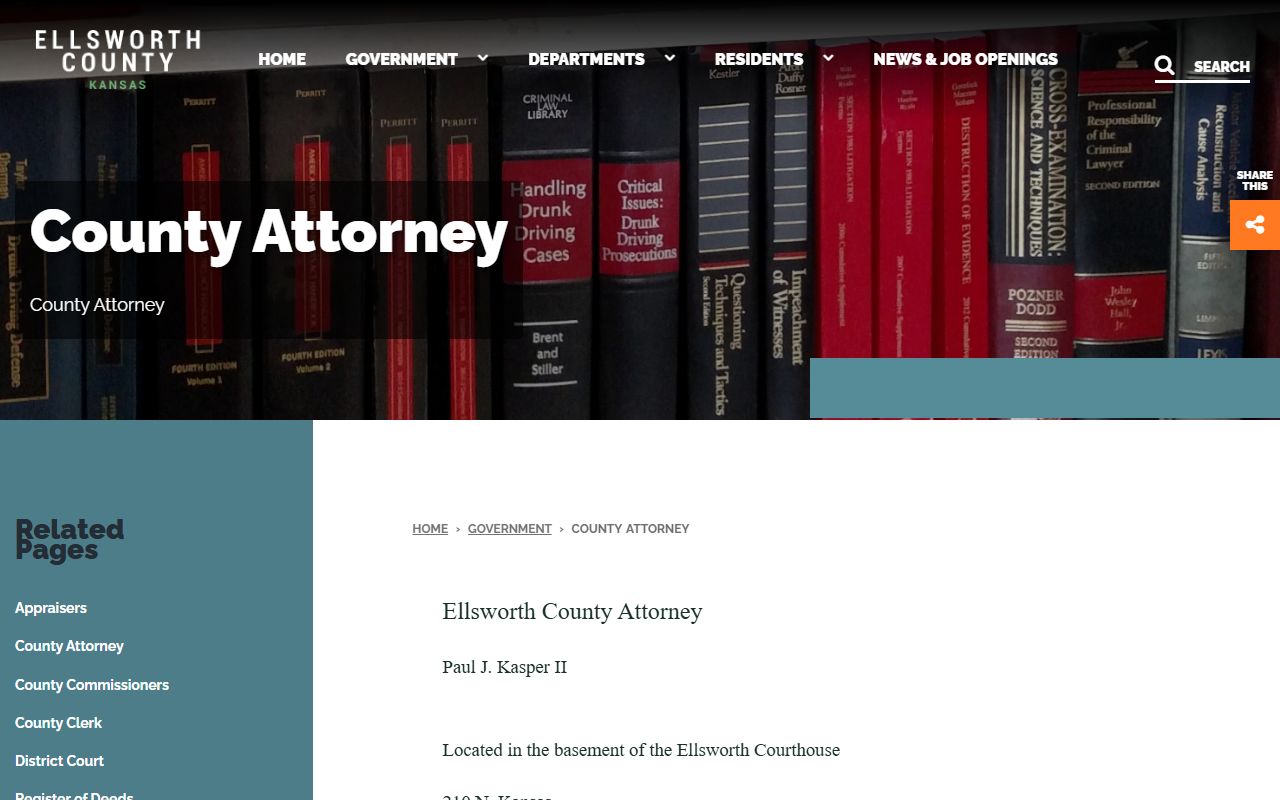
The County Attorney is relevant because the prosecutor files and amends state criminal charges that later appear in the district court record.
Search Ellsworth County Criminal Cases
The main online lookup for Ellsworth County criminal court records is Kansas Judicial Branch CaseSearch. The research identifies CaseSearch as the statewide public district court case search, with inputs such as case number, party name, business name, citation, and other criteria available for the user's role. For criminal cases, a defendant name or exact case number is usually the most useful search key.
- Open Kansas CaseSearch and search by defendant name or exact district court case number.
- Confirm that the result is tied to Ellsworth County District Court or the correct 20th Judicial District record.
- Review case type, filing date, parties, judge, current status, and public docket entries.
- Read charge, plea, disposition, sentence, probation, fine, restitution, and warrant entries in order.
- Ask the Clerk of the District Court for certified copies, older files, or documents not available online.
KBI criminal-history checks are separate from court case files. A statewide criminal-history record check may aggregate criminal justice information, but the district court file is the court record for one prosecution. KDOC KASPER and the KBI offender registry are also different systems. They should not be treated as complete Ellsworth County criminal court records.
Ellsworth County Criminal Case Flow
Criminal court records make the most sense when read as a sequence. The case begins with a charge filed by complaint, information, citation, or other charging paper. The court then records appearance, bond, counsel, hearings, motions, plea or trial results, disposition, and sentencing. Later entries may involve probation review, restitution, warrant status, expungement, appeal, or post-conviction motions.
Case flow: Charges Filed › Arraignment › Pretrial / Motions › Plea or Trial › Disposition › Sentencing
| Stage | What Happens |
|---|---|
| Charges Filed | The prosecutor files the criminal complaint, information, citation, or count that opens or defines the case. |
| Arraignment | The defendant is advised of the charge and enters a plea, or the court records a later plea setting. |
| Pretrial / Motions | The parties file motions, request orders, prepare for hearing, and resolve evidence or scheduling issues. |
| Plea or Trial | The case is resolved by plea, trial, dismissal, amendment, or other disposition. |
| Sentencing | The court imposes jail, prison, probation, fines, costs, restitution, supervision, or other terms after conviction. |
Ellsworth County Criminal Record Fields
The field-by-field record matters because a criminal case can contain dismissed counts, amended counts, diversions, warrants, and sentence terms in the same file. A person checking a case should not stop at the first charge listed. The disposition and sentencing entries show how each count ended and what the court ordered.
| Field | What It Shows |
|---|---|
| Case Number | The official criminal case identifier used by the district court or eCourt system. |
| Defendant | The person charged in the criminal case. |
| Prosecutor | The State of Kansas through the Ellsworth County Attorney when locally prosecuted. |
| Defense Counsel | Private attorney, appointed counsel, BIDS-linked counsel, or pro se status when listed. |
| Charges | Statute, description, count number, severity, offense date, arresting agency, and amendments if public. |
| Hearings | First appearance, preliminary hearing, arraignment, motion hearing, trial, plea, sentencing, or review dates. |
| Plea | The defendant's answer to a charge, such as guilty, not guilty, or other plea entry. |
| Disposition | The outcome of each charge or case, such as dismissed, convicted, acquitted, diverted, or judgment entered. |
| Sentence | Jail or prison, probation, fines, costs, restitution, supervision, and special conditions when public. |
Ellsworth County Charges vs Convictions
A charge is an accusation. A conviction is an outcome after a guilty plea, verdict, or other court finding. Ellsworth County criminal court records can show both, and they can also show charges that were amended, reduced, dismissed, diverted, or resolved without a conviction. That is why the full case file is different from a charge-only lookup.
| Charge | Conviction | |
|---|---|---|
| Meaning | An allegation filed in court by complaint, information, citation, or count. | A court outcome based on plea, verdict, or finding of guilt. |
| Timing | Appears near the start of the criminal case or after amendment. | Appears after plea, trial, or final court action on the count. |
| Record Risk | May later be dismissed, reduced, or amended. | May trigger sentence, probation, fines, restitution, or driver and licensing consequences. |
| Best Source | Charge section, complaint, information, citation, or docket entries. | Disposition, journal entry, sentencing order, and final docket entries. |
Note: A case can have several counts, so read each count's disposition instead of assuming one outcome covers the whole file.
Ellsworth County Criminal Court Roles
The Ellsworth County Attorney is Paul J. Kasper II. The official county page places the County Attorney in the basement of the courthouse at 210 N. Kansas, Ellsworth, Kansas 67439, with phone 785-472-4244 and hours Monday-Friday, 8:00 a.m. to 5:00 p.m. That office is the local prosecutor for state criminal cases filed in Ellsworth County District Court. Prosecutor actions can appear in the criminal court record as filed charges, amended charges, dismissals, diversion-related filings if filed, plea agreements, sentencing positions, or notices.
No Ellsworth County public defender office was located on the county site. The Kansas State Board of Indigents' Defense Services is the statewide authority for defense counsel through public defender or assigned-counsel systems. If a defendant cannot afford an attorney in an Ellsworth County criminal case, the district court is the place to ask about appointed counsel and BIDS procedures. The research also notes Ellsworth Probation Services at 785-472-3832 and a 20th Judicial District Community Corrections Ellsworth satellite at 209 N. Kansas Ave.
The K.S.A. 22-4522 BIDS authority source supplies the successful indigent-defense image for this criminal court records page.
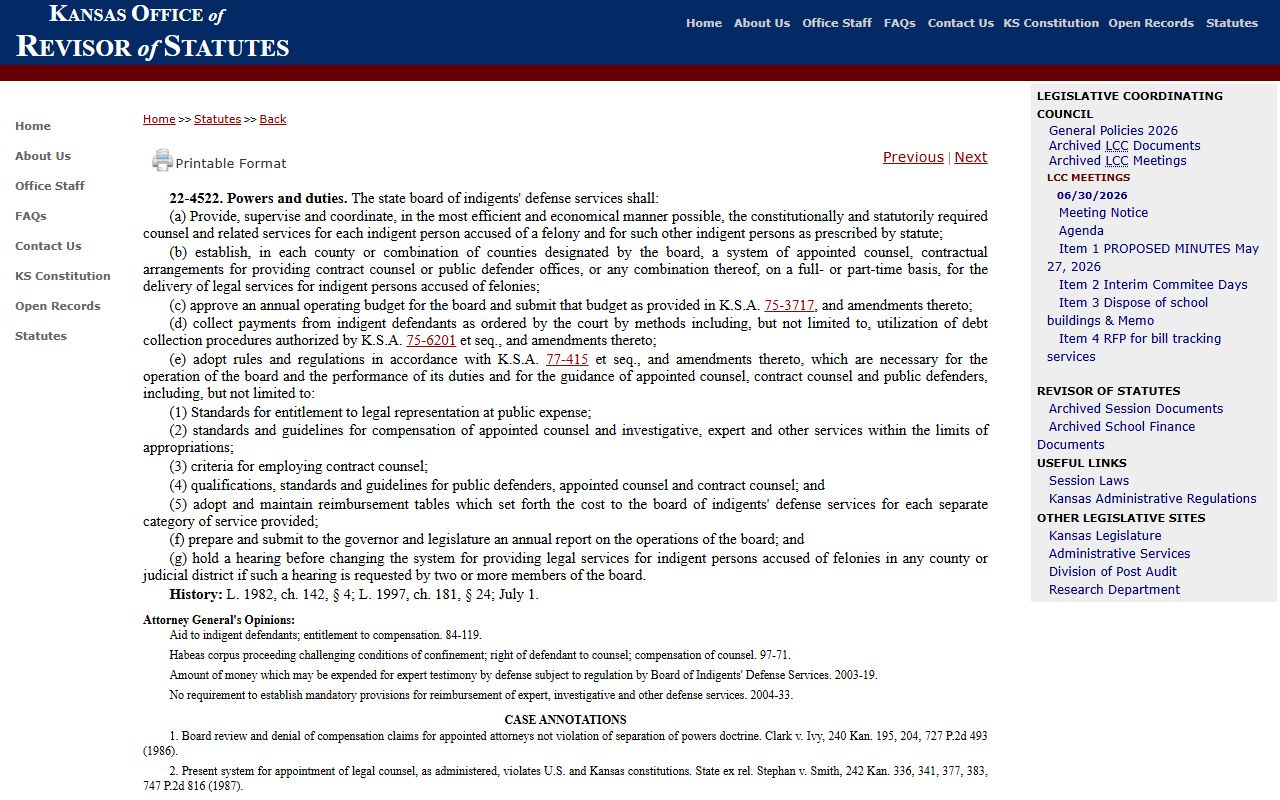
Defense counsel information can help interpret docket entries, but attorney appointment does not change the clerk's role as custodian of the court file.
Ellsworth County Sealed vs Expunged
Restricted criminal court records require careful wording. Juvenile files have special access rules under Kansas law. Sealed or expunged adult records may not appear in public search results, or they may show only limited information. Personal identifiers, protected addresses, minor names, financial account numbers, sealed documents, and confidential case types may be redacted or withheld.
| Sealed | Expunged | |
|---|---|---|
| Public View | Hidden or limited from public access by court order or rule. | Limited by a statutory expungement order when eligibility and process are met. |
| Where It Starts | Through court handling, confidentiality rules, or a sealing order. | Through a petition filed in the court with jurisdiction over the arrest, diversion, conviction, or adjudication. |
| Kansas Source | Rule 22 and confidentiality rules affect public electronic access. | K.S.A. 21-6614 governs many adult expungements. |
| Remaining Access | May remain available to parties, agencies, or the court in allowed situations. | May remain available for law-enforcement, licensing, or statutory uses listed by law. |
The Kansas criminal expungement statute source is the successful image source tied to restricted criminal court records.
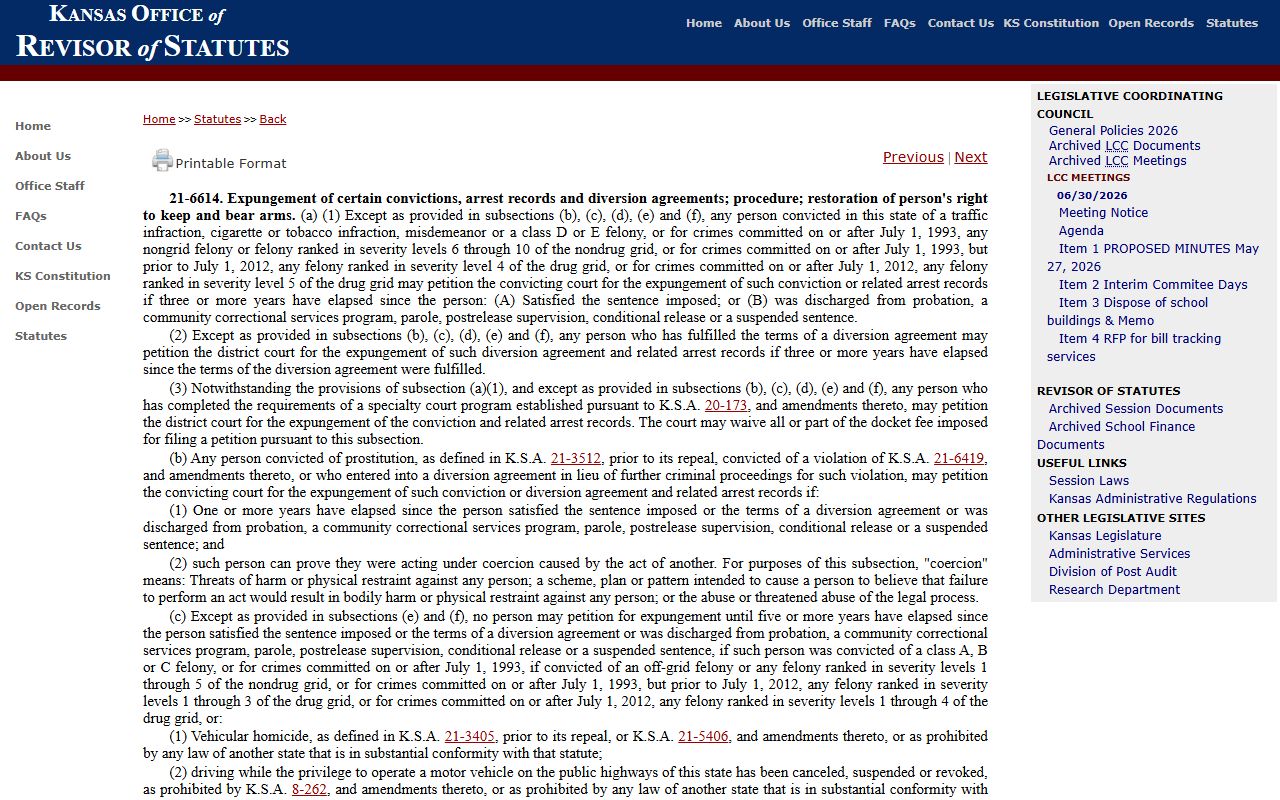
That statute is central to adult expungement, while juvenile access is handled under a separate juvenile-records statute.
Public Access to Ellsworth County Criminal Records
Public access to Ellsworth County criminal court records comes through the same court and open-records framework used for other district court records. Kansas Supreme Court Rule 22 controls public electronic access to district and appellate case records. K.S.A. 45-215 et seq. is the Kansas Open Records Act framework, while K.S.A. 45-218 addresses inspection and copying procedures and K.S.A. 45-219 allows fees for lawful record production costs.
The local fallback is the Clerk of the District Court at 210 N Kansas Ave, Ellsworth, KS 67439. The phone number is 785-472-4052, fax is 785-472-5712, email is EW.DCPublic@kscourts.gov, and hours are Monday-Friday 8:00 a.m. to 5:00 p.m. Kansas also provides a statewide court-record request channel and says requests are acted on by the end of the third business day after receipt. For all Ellsworth County court records beyond criminal cases, the broader process is summarized in Ellsworth County court records.
Note: A public docket entry does not guarantee public access to every criminal document image or sealed attachment.
Restricted Ellsworth County Criminal Records
Kansas juvenile court records and official files are addressed by K.S.A. 38-2309. Juvenile information may be kept separately and may have limited disclosure. Adult sealed or expunged records may be absent from CaseSearch or may show limited public information. Investigative law-enforcement records are different from the court case file and may be restricted under open-records exceptions, especially while an investigation is active.
When a record is missing from a criminal court records search, the missing result does not always mean the case never existed. The file may be municipal, sealed, expunged, juvenile, older than online coverage, miskeyed by name, stored in a non-digitized form, or held by a different agency. The best next step is to verify the court, case number, defendant spelling, date range, and record type with the Clerk of the District Court or the appropriate municipal clerk.